> Society > Local History


ki khobor, bhale aase? (How are you? All well?)
A simple exchange, whose soothing expression momentarily slows our passage amidst the hurried rhythm of Pan Bazar's bustling corners. A smile on our face followed by a jovial response builds the steady flow of conversation, creating a moment when one suddenly realises their return to something intimate, almost maternal- home. And then follows the smooth transition, in the lines of a suggestion, which echoes - Ebar Mahamaya r pora ahu bolok (Let's come from Mahamaya once)
At the heart of Pan Bazar's urban clamour, where the road splits into four and the traffic converge under a single traffic light, stands a restaruant whose brown wooden doors remain slightly ajar. Rarely can a structure situated at the centre of an economic hub, stay hidden from the city’s urban glare. But, with a rectangular black signboard that reads MAHAMAYA RESTAURANT, marks a landmark whose bold-white letters carry a legacy that was established in 1918.
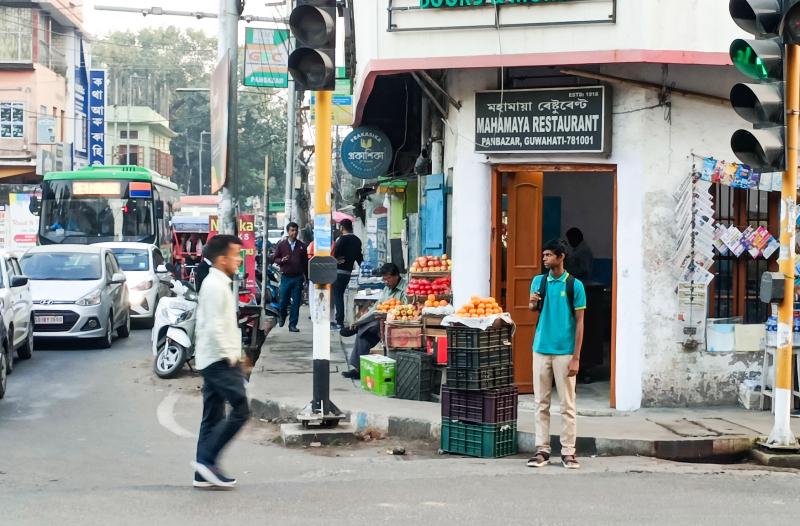
Photo-Rohit Pathak
Mahamaya began when Naroram Barman along with his family, arrived in Guwahati from the quiet corners of Nalbari. Chasing dreams of a better life, the entire community found its foothold in the business of opening restaurants and eateries across Pan Bazar. Similarly, Naroram Barman also started his business that began with a tea stall named Mahamaya cabin, established in 1918. However, as informed by Indrajit Barman (the current proprietor and third generation Barman) Naroram’s failing eyesight slowed Mahamaya’s initial growth. Yet, for forty-six years the shop endured, steadily carving itself as a quiet force rising overtime. Eventually, it doubled as a stationery store which became a habitual stop for students in Cotton College, often seen buying stationeries or gorging on items such as tea, Goja, Khurma and Rasgulla . In the year 1964, when Naroram Barman took his last breath, his son, Arjun CH barman took over the reins, ushering Mahamaya into, what many recall as its defining phase.
Educated at the prestigious institution of Cotton College (present Cotton University), Arjun Barman’s vibrant persona and silver tongue transformed the restaurant into more than an eatery. From a gentle nudge to a warm smile that unfolded into small gatherings and post-exam celebrations by students of Cotton College, Cotton Collegiate Higher Secondary School, Handique Girls' Col and other educational institutions in Pan Bazar, Arjun’s reassuring presence turned Mahamaya into a space of joy and comfort. And the food served at Mahamaya - a collection of freshly prepared items that include paratha, rice, dal, mutton biryani, chicken pulao, and Goja paired with tea - ensured an atmosphere whose allure kept customers rooted within the shop. All came only to be held back within the livid environment fuelled by its proprietor, who balanced his time between studies at Cotton college and the responsibilities of Mahamaya. Arjun’s presence also led towards the buildup of a distinct craft in the hands of certain cooks and management. His travels to cities such as Mumbai, Kolkata and Delhi further shaped his vision of innovation tied with tradition, strengthening Mahamaya’s essence.
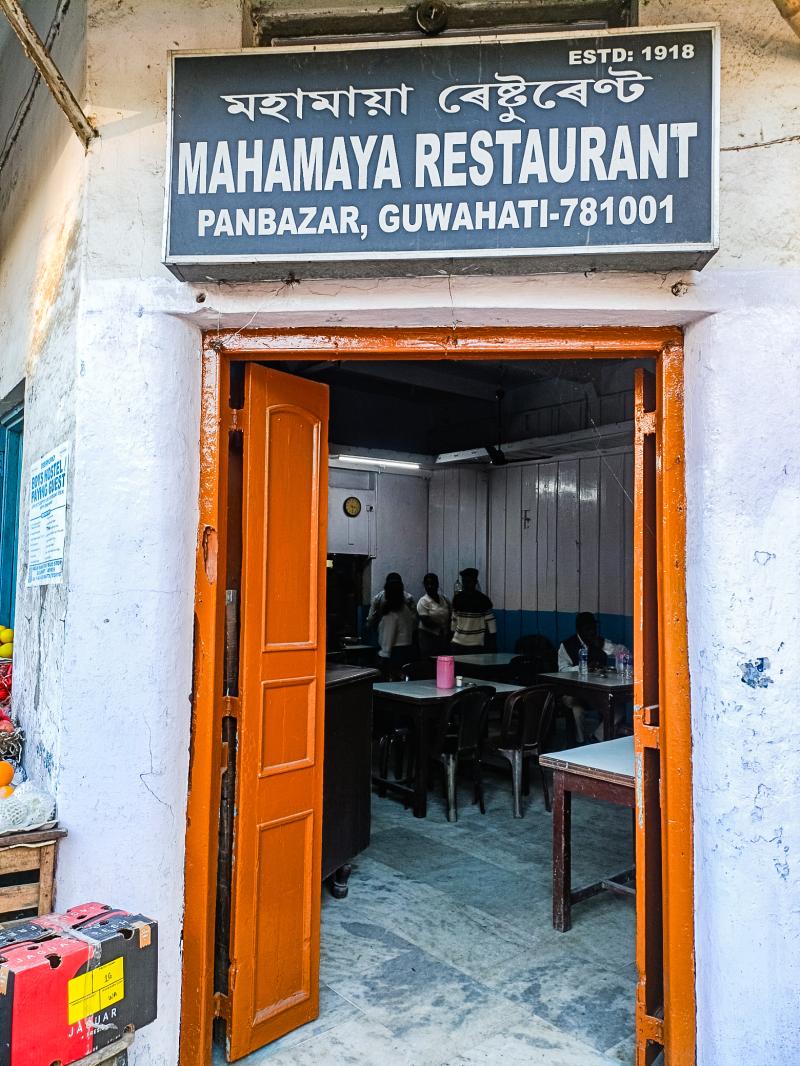
Photo-Rohit Pathak
And as Guwahati evolved with rapid development and shifting tides, Mahamaya moved through the present and emerged resilient. Neither did it change in its identity nor in its rote methods. The traditional menu, decor, seating arrangements, old ceiling fans, and unaltered ambience, all remained intact. It was a place where people left with their bellies full and their minds satisfied. But Mahamaya no longer remained a mere restaurant; it came to symbolize a sanctuary that preserved a shared bond among the city’s inhabitants.
Stories often describe an intimate atmosphere, where soft Assamese songs were heard playing in Mahamaya’s background as laughter rose from immaculately cleaned tables; each provided with a bowl of green chilies (sprinkled with salt) and water jugs. And then, piping hot dishes emerging from the kitchen would hush tones, as heads turned towards food that emancipated a misty warmth. A single bite - a paratha, a chunk of meat or a handful of rice- often unfolded into a long-animated relish, where plates were passed, stories were exchanged, and the dining hall buzzed with joy. And the booming presence of Arjun Barman infused the space with an energy unmatched by many. In fact, as Indrajit mentions, under his father's presence, Mahamaya tuned a frequency that changed from a restaurant at dawn to a club-cum-chai adda by dusk. By evening, a different energy would take over Mahamaya as laughter, music, joy, and a quiet sense of calm spread through its corners. People from district courts, academics from Cotton College, residents of Pan Bazar and other areas of Guwahati would gather with a single expression pursing their lips- "Aaji Mahamayat ei khai jau”.
In fact, noted musician Dr. Siba Gogoi describes (in NEZINE’s podcast by Anusha Borgohain) how he along with renowned musicians, music Directors and singers, the likes of Ramen Choudhury, Kula Baruah, Atul Medhi, Ranen Barkataki, Syed Sadullah and others formed the band- Melodica, during their evening gatherings at Mahamaya. His is a story that describes how Melodica, “Guwahati’s earliest live western-influenced Assamese band”, carved its ascension from the quiet corners of a landmark located at Pan Bazar’s intersection. ( https://www.nezine.com/info/UzBPNW42VlRNeG5VWDFVUUpGejlqUT09/mandolin-and-accordion:-assam%C3%A2%E2%82%AC%E2%84%A2s-fusion-music-journey.html [11.00-11.30]
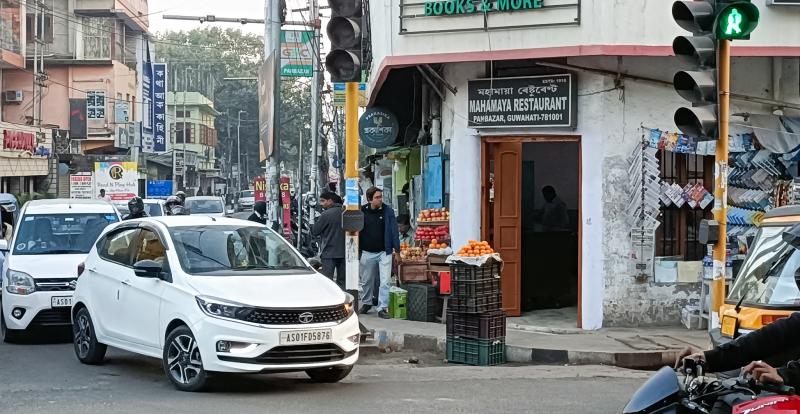
Photo - Rohit Pathak
The decadent spirit of Mahamaya’s timeless existence is further made evident by Atanu Kr Chowdhury, one of its loyal patrons. An alumnus of Cotton college and Retired Vice Principal and Former Head of the Economics Department in Pragjyotish College, Atanu Chowdhury paints a vivid picture of a time when Pan Bazar was still a quiet economic hub in Guwahati. He draws attention to a period of late 1970s when Assam was undergoing a volatile period of protests and political movements (anti foreigners’ agitation). With media being almost non-existent, Chowdhury explains how Pan Bazar became the sole hub where people gathered to exchange stories, vital information and emotions. And these trips across Pan bazar would often unfold into a visit to Guwahati Dairy and Mahamaya Restaurant, where tea was priced at a modest 25 paise and pulao costing only a few paise more.
Chowdhury further talks about the ambience of past Mahamaya, where students from Cotton College and a working crowd used to fill its corners. And amidst the ritual laughter and joy, there was the presence of Arjun CH Barman, often found sitting at Mahamaya's counter with a smile on his face and a congenial personality that greeted all. It was a very different period, he explains, as a sense of uncertainty pushed through Guwahati’s collective consciousness (loss of an entire academic year due to protests during Assam Movement). Yet, amidst this unease, a quiet harmony took hold in Pan Bazar. Its tranquil streets and vivacious extensions- Guwahati Dairy, Mahamaya Cabin, Shaikh brothers -emerged as habitual stopping points for the public. “Usually olop evening time ot gole,tekhet xokolor khub famous aasil eta xomoyot pulao aaru chicken, eitu khua mur monot ase” reminisces Atanu Chowdhury as he describes Mahamaya (and Pan Bazar)- a space where routine conversations and familiarity rejuvenated the city’s consciousness.
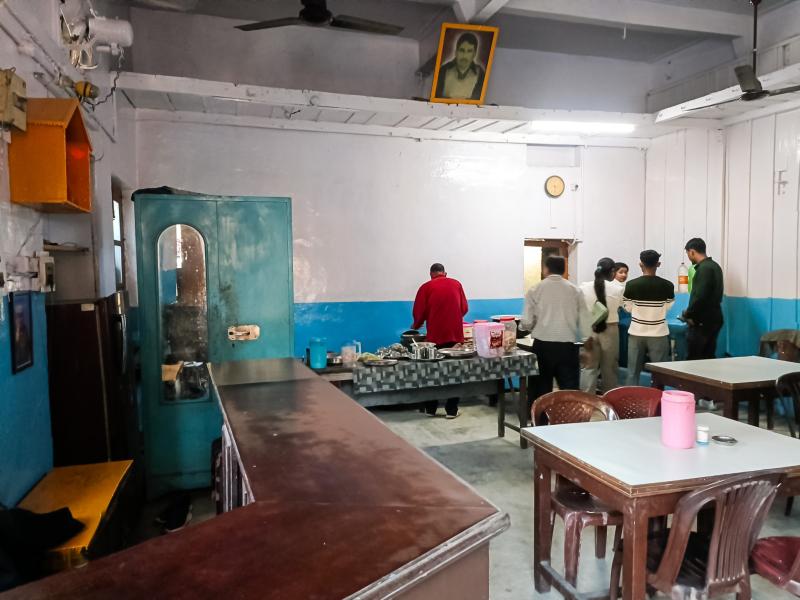
Photo - Rohit Pathak
Such memories and folklore describing Mahamaya Restaurant, still finds its existence in 2025. Yet, a sense of curiosity stirs when one notices a shop with doors that remain slightly ajar. A gentle knock followed by a quick gaze, and the restaurant is indeed open for business. However, a quiet urgency seems to have replaced the much-heard bustle of Mahamaya’s vibrant indoors. The tables with the usual amenities of a water jug and a bowl of green chilli remain. But familiar sights draw a sense of disheveled unfamiliarity, when customers notice the disorganised layout covering present-day Mahamaya. The kitchen had been shifted to the restaurant’s dining area, the management was in a semi-coherent state ran by only three people (proprietor and two staffs), most of the items in the menu were unavailable, and the indoor bustle lay barren with the occasional sip of tea and murmur of disappointed expressions. Behind the counter on the left stands Indrajit Barman, the current proprietor of Mahamaya Restaurant, whose strained presence brings our attention to a tragedy.
A few months earlier, Arjun CH Barman, father of Indrajit and Mahamaya's helmsman passed away. His death marked the quite close of a life that steered Mahamaya through decades of hard work and commitment. Despite his old age, it was an incident that came as a shock to both Indrajit and the wider community. Arjun Barman’s absence is palpable in the store with regulars often heard uttering, “Aagor Mahamaya naai aaru” (the old Mahamaya is no more.)
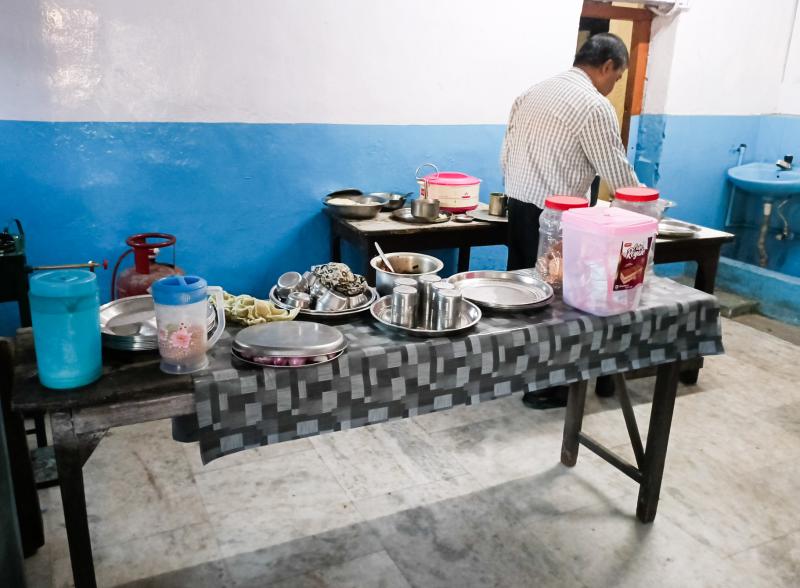
Photo- Rohit Pathak
After a quiet reflection, Indrajit speaks candidly of the challenges he faces that include rising costs, departure of long-standing staff (following his father’s demise), failure to meet customer expectations, and the absence of his father’s guiding presence. Yet, Indrajit’s eyes remain sharp and voice steady, as he speaks of the resolve needed to carry Mahamaya forward. While narrating the aforementioned history, he also explains- “I know that the past-old Mahamaya is no more, things are not like before, and I know my father's immense contribution to its success. I also know that I am new in the business since I didn’t pay attention before. But I will continue to navigate Mahamaya steadily over time, because everything is on me now. The decades of food, delicacies and food habits that Mahamaya has cultivated since, I will not bring any changes to that. However, I will ensure the qualitative service of Mahamaya remains the same, with my simultaneous attention towards learning the craft and business.”
Thus, in an era where development seems to outpace the remnants of time, Pan Bazar reflects the fragments of how life used to be. Amidst the glimmering signboards and radiant narratives, stands Mahamaya at fragile crossroads. Yet, its embers persist- kept alive by the proprietor’s words, by quiet regulars, inherited responsibilities, and the shop’s enduring aura- refusing to be extinguished.
The question then lingers- how can we ensure that this pillar of Assamese heritage remains standing in a volatile period. Atanu Chowdhury mentions about a steady group of people whose keen enthusiasm lies in visiting such establishments and experiencing the distinct quality upheld over a century. He further informs that if Mahamaya under Indrajit’s helm, begins to provide regular service without delays, and adapts to changing circumstances by introducing snacks to compete with street foods; the shop will undoubtedly see a light at the end of the day. Hence, to provide a century of trust with a fleeting belief in Mahamaya’s endurance might help preserve its legacy. As kinship, after all, is a two-way relationship that forges bonds beyond material needs and desires. And so is Mahamaya, an eatery that transcends beyond the function of satiating the appetite of Guwahati’s citizens.
 Navigations
  Quick Contact
 Subscribe Us
 Quick Mail